
Designing Microfluidic Chips: Create, Model, and Fabricate
Welcome to Simuall’s Microfluidic Chip Design blog, your one-stop solution for state-of-the-art lab-on-chip design and optimization. We offer a wide range of services to help you realize your ideas, whether you’re creating a lab-on-a-chip for medical testing, investigating microreactor design for chemical synthesis, or creating an organ-on-chip for biomedical research. Your project will be optimized for performance, fluid flow, and scalability thanks to our ability in microfluidic modeling, simulation, and prototyping.
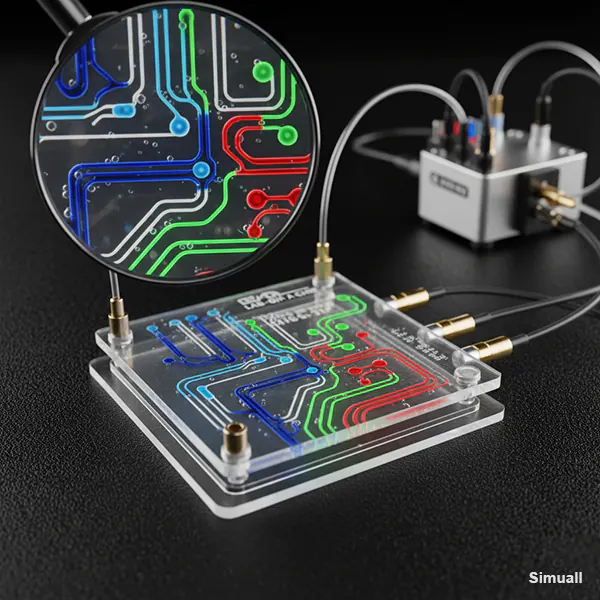
Simuall understands the complexities of microfluidic systems and the specific needs of researchers, engineers, and innovators. This page aims to assist you in learning the steps involved in microfluidic chip design by providing you with information, services, and solutions tailored to your needs. Let’s discuss how we can help you create novel, precise, and effective microfluidic devices.
Microfluidic Chip Design: What Is It?
Designing microfluidic chips entails building small devices that can control tiny fluid volumes—usually in the range of microliters or nanoliters—in microchannels. These chips serve as the foundation for technologies such as organ-on-chip design, lab-on-a-chip design, and point-of-care diagnostics, which enable uses in chemical analysis, drug development, medical diagnostics, and more.
When someone searches for “microfluidic chip design,” they probably want to know how to create a chip that satisfies certain functional needs, like accurate fluid control, compatibility with biological samples, or sensor integration. From channel geometry and flow dynamics to material selection (such as PDMS for PDMS microfluidic chip fabrication), Simuall specializes in custom microfluidic chip design, satisfying all of the chip’s requirements.
In order to optimize your design, we first understand your application, whether it is droplet microfluidics for single-cell analysis or blood flow modeling for vascular studies. We then use sophisticated tools like COMSOL microfluidic simulation and Ansys microfluidic simulation. Working with us provides you access to knowledge that guarantees your chip will function dependably under everyday circumstances.
Why Pick Simuall for Services in Microfluidic Chip Design?
You want a partner that can provide accuracy, creativity, and efficiency when you’re looking for microfluidic chip design services. This is what makes Simuall unique:
- Proficiency in Microfluidic Simulation and Modeling
Our team predicts and optimizes fluid behavior within your chip using cutting-edge microfluidic modeling techniques. Critical parameters such as flow rates, pressure drops, and mixing efficiency are analyzed using COMSOL and Ansys microfluidic simulation. This guarantees that your design is solid before proceeding with microfluidic prototyping. To see how we incorporate simulation into the design process, find out more about our Ansys consulting services and COMSOL simulation services. - Tailored Approaches for Various UsesWe customize our approach to your special goals, whether it be organ-on-chip design for drug testing or microreactor design for chemical synthesis. We provide solutions that meet your technical and funding requirements, whether you require a sophisticated lab-on-a-chip modeling for diagnostics or a PDMS microfluidic chip for quick prototyping.
- Complete Microfluidic Prototyping
Chip design is just the beginning. Our microfluidic prototyping services ensure smooth transitions between design and production by taking your idea from simulation to fabrication. We save you time and money by managing every step, from the creation of microfluidic devices to testing and validation.
- Microfluidic Design Outsourcing for Efficiency
Outsourcing microfluidic design to Simuall is revolutionary for businesses and researchers trying to optimize their workflow. Our team produces excellent designs without requiring internal resources by combining knowledge of fluid dynamics, materials science, and engineering. To find out how we maximize fluid behavior in microfluidic systems, check out our CFD consulting.
By choosing Simuall, you’re dealing with a group of people committed to advancing the field of microfluidic technology rather than just a service provider.
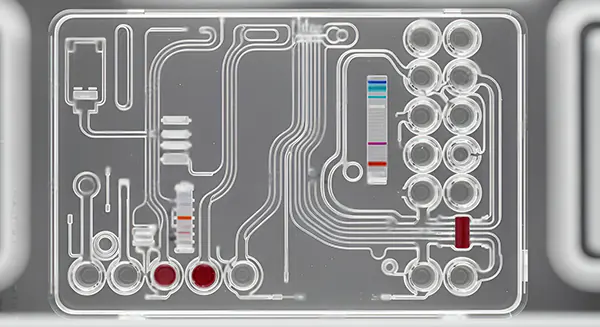
Important Uses for Microfluidic Chip Design
Industries are undergoing a revolution thanks to microfluidic chip design, which makes precise microscale fluid control possible. We support the following applications, which are among the most exciting:
- Point-of-Care Diagnostics Lab-on-a-Chip DesignLab-on-a-chip technology is perfect for point-of-care diagnostics because it combines several laboratory operations onto a single chip. With results available in minutes, these devices allow for quick, portable testing for infectious diseases or diseases like diabetes. Your chip will have the sensitivity and specificity required for diagnostic applications thanks to our microfluidic simulation tools.
- Design of Microreactors for Chemical Synthesis
Because microreactor simulation allows for precise control over reactions in small volumes, it is altering the chemical and pharmaceutical industries. Our microreactor modeling services employ complex simulations to predict reaction kinetics and heat transfer, whether you’re creating new compounds or modifying reaction conditions. To see how we produce complex 3D models for microreactor components, view our SolidWorks 3D modeling services.
- Designing Organs on Chips for Biomedical Research
Organ-on-chip technology provides a novel platform for drug testing and disease modeling by simulating the physiological behavior of human organs. We guarantee that your organ-on-chip system faithfully simulates biological environments by integrating blood flow modeling, which improves the dependability of your study results.
- Using Droplet Microfluidics for Accurate EvaluationDroplet microfluidics makes it possible to manipulate small fluid droplets for uses such as drug encapsulation and single-cell sequencing. Whether your use case is emulsion production or high-throughput screening, our background in microfluidic modeling guarantees that droplet generation and manipulation are optimized for your particular situation.
Our Methodology for Microfluidic Design
Simuall uses a thorough yet efficient procedure to produce microfluidic chip designs of the highest possible standard:
Analyzing requirements and conceptualization
We begin by comprehending the objectives of your project, whether it is creating a sophisticated microfluidic chip design for diagnostics or a microreactor for exothermic reaction. Important parameters such as material properties, flow requirements, and channel dimensions are defined.
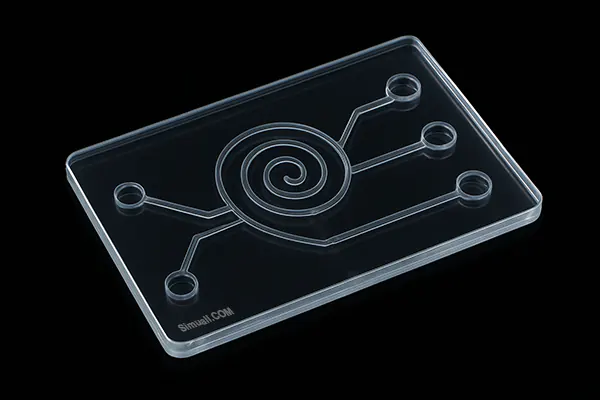
Microfluidic Simulation and Modeling
We model mass transport, heat transfer, and fluid behavior within your chip using COMSOL and Ansys microfluidic simulation. By spotting possible problems early, this step reduces fabrication time and expenses. We offer deeper insights into fluid dynamics optimization through our CFD consulting services.
Design Optimization
Based on simulation results, we refine the chip’s geometry, materials, and flow paths to ensure optimal performance. For example, in droplet microfluidics, we fine-tune Y-joint (T-joint) angle, channel length etc. to achieve consistent droplet sizes.
Why Simulation is Critical for Microfluidic Chip Design
Microfluidic simulation is the cornerstone of successful chip design. By modeling fluid behavior before fabrication, we can predict how your chip will perform under real-world conditions. Tools like COMSOL microfluidic simulation and Ansys microfluidic simulation allow us to:
- Analyze mixing status in micromixers.
- Optimize joint angle for droplet microfluidics.
- Predict heat transfer and mass transfer in microreactor modeling.
- Simulate biological interactions in organ-on-chip design.
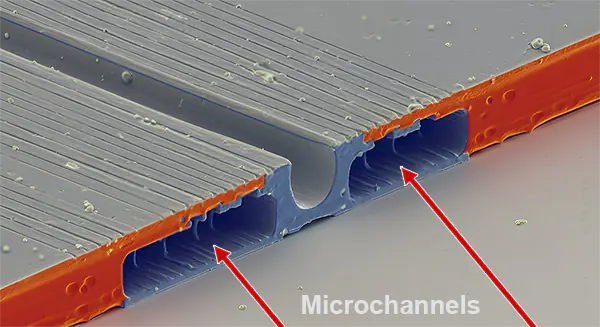
Simulation guarantees that your chip performs as expected and reduces the risk of expensive redesigns. To find out how we use cutting-edge tools to improve your project, read more about our COMSOL microreactor simulation.
Materials and Fabrication Technique Selection
For the fabrication of microfluidic devices, selecting the appropriate materials and fabrication techniques is essential.
Fabrication of PDMS Microfluidic Chips:
-
PDMS Microfluidic Chip Fabrication:
The biocompatibility, transparency, and ease of prototyping of polydimethylsiloxane (PDMS) make it a popular option. To produce accurate microchannels for uses such as point-of-care diagnostics.
- Glass and Silicon:
For high-precision or high-pressure applications, chips fabricate using glass or silicon, ensuring durability and chemical resistance. - 3D Printing:
For rapid microfluidic prototyping, advanced 3D printing techniques is being used to create complex geometries with high accuracy.
Also you can use our SolidWorks rendering service to visualize and refine these designs before fabrication.